
Schema Therapy

“What do we put first in our lives? Values may have a connection to schemas; for example, an individual may overvalue money because a schema of mistrust taught him to not trust others, so financial security becomes a prime focus in life.”
Simeone-DiFrancesco, Roediger & Stevens, p250.
Schema Therapy Resources
Healthy Adult can address needs, and re-parent and co-parent the self (with partner or therapist, or even God), so that the needs are considered and ultimately receive “good enough” responses by the self or others through appropriately assertive action plans. The modes turn up unhealthy rough edges when the “needs” seek fulfillment by demanding inflexibility, rigid thinking, and fear-restricted choices, which are actually wants.” (Simeone-DiFrancesco, Roediger & Stevens p. 224).
Client’s Guide to Schema Therapy
Schema Therapy for Couples & Marriages

Being better together should feel a little bit more comfortable than this. Why not give it a try!

NON-THERAPY ALTERNATIVES, NOT ADDRESSING MENTAL HEALTH CONDITIONS
If therapy is too expensive, have you considered making a workshop with Dr. Simeone-DiFrancesco? If you are not a client, you may wish to see workshop offerings at: Portiuncula Oratory, Inc., or free webinars at Jesus-Centered Institute.org
Being better together might look something like this → Can you image what a perfect day would be like? That will help us get there.

Professional training for providers
Please go to: Jesus-CenteredInstitute.org/jesus-centeringforprofessionals/
(Please note, Professional training is not the provision of psychotherapy or a client/therapist relationship.)

CLICK HERE TO VIEW THE SCHEMA THERAPY EVIDENCE BASE (and this is only partial!)
Dr. Simeone-DiFrancesco highlights some materials for you:
About Schema Therapy for children: http://www.schematherapy-for-children.de/
Schema Therapy slide shows: http://www.schematherapy.com/id29.htm
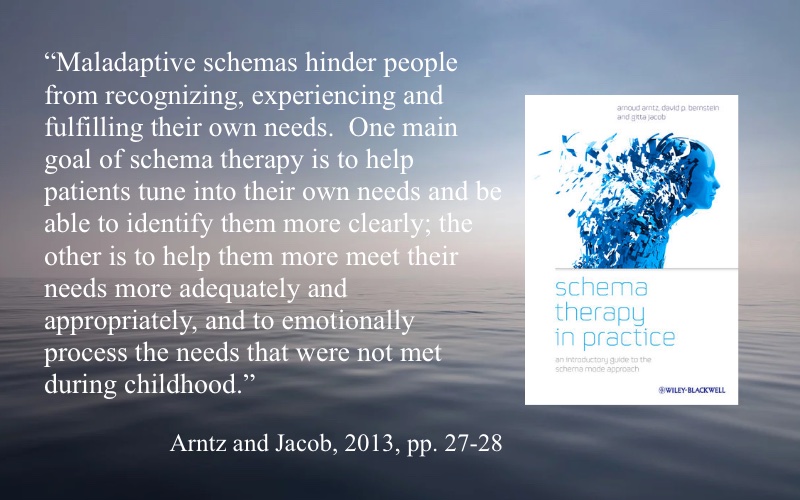
Arntz, A. Schema Therapy in Practice: An Introductory Guide to the Schema Mode Approach. Wiley-Blackwell, 2012.
Rafaeli, E., Bernstein, D., Young, J. Schema Therapy: Distinctive Features (CBT Distinctive Features), Routledge, 2010.
A more thorough Schema Therapy Bibliography:
Pertinent Schema Therapy Research
(Please note, the two largest trials have ***.)
Note: materials below are taken with permission from Professor Lawrence Riso’s compendium.
Schema Therapy Defined (History, Definition, and Contrast with CBT; Schema Therapy with Diverse Populations; Research Support; Core Emotional Needs; Schema Modes.
Flanagan, C.M. (2014). Unmet needs and maladaptive modes: A new way to approach longer-term problems. Journal of Psychotherapy Integration, 24(3), 208-222.
Heilemann, M.V., Pieters, H.C., Kehoe, P., & Yang, Q. (2011). Schema therapy, motivational interviewing, and collaborative-mapping as treatment for depression among low income, second generation Latinas. Journal of Behavior Therapy and Experimental Psychiatry, 42, 473-480.
Schema Modes; Orienting the Patient
***Bamelis, L.M., Evers, S.M.A.A., Spinhoven, P., & Arntz, A. (2014). Results of a multicenter randomized controlled trial of the clinical effectiveness of schema therapy for personality disorders. American Journal of Psychiatry, 171, 305-322.
Roediger, E., Stevens, B.A., & Brockman, R. (2018). Contextual schema therapy: An integrative approach to personality disorders, emotional dysregulation, and interpersonal functioning. (pp. 39-54). Context Press, New Harbinger Publications.
Guided Imagery; Ethics and Guided Imagery
ten Napel-Schultz, M.C., Abma, T.A., Bemelis, L., & Arntz, A. (2011). Personality disorder patients’ perspectives on the introduction of imagery within schema therapy: A qualitative study of patients’ experiences. Cognitive and Behavioral Practice, 18, 482-490.
Arntz, A. (2011). Imagery rescripting for personality disorders. Cognitive and Behavioral Practice, 18, 466-481.
Guided Imagery (cont.); Limited Reparenting
Wheatley, J., & Hackmann, A. (2011). Using imagery rescripting to treat major depression: Theory and practice. Cognitive and Behavioral Practice, 18, 444-453.
Rafeali, E., Bernstein, D., & Young, J. (2011). Schema therapy: Distinctive Features. (71-74). New York, NY: Routledge/Taylor & Francis Group
Chair Work
Roediger, E., Stevens, B.A., & Brockman, R. (2018). Contextual schema therapy: An integrative approach to personality disorders, emotional dysregulation, and interpersonal functioning. (pp. 179-197). Oakland, CA: Context Press, New Harbinger Publications.
Pugh, M. (2017). Chairwork in cognitive behavioural therapy: A narrative review. Cognitive Therapy and Research, 41, 16-30.
Chair Work (cont.); Mindfulness and Schema Therapy
Roediger, E. (2012). Why are mindfulness and acceptance central elements for therapeutic change in schema therapy too? An integrative perspective. In M. van Vreeswijk, M., J. Broersen, & M. Nadort (Eds.), The Wiley-Blackwell handbook of schema therapy: Theory, research, and practice (pp. 230-239). Chichester, UK: Wiley-Blackwell.
Schema Therapy with Cluster B Personality Disorders; Schema Therapy Techniques
*** Giesen-Bloo, J., van Dyck, R., Spinhoven, P., van Tilburg, W., Dirksen, C. van Asselt, T., Arntz, A. (2006). Outpatient psychotherapy for borderline personality disorder: Randomized trial of schema-focused therapy vs transference-focused psychotherapy. Archives of General Psychiatry, 63(6), 649-58.
Farrell, J., Shaw, I., & Reiss, N. (2012). Group schema therapy for borderline personality disorder patients: Catalyzing schema and mode change. In M. van Vreeswijk, M., J. Broersen, & M. Nadort (Eds.), The Wiley-Blackwell handbook of schema therapy: Theory, research, and practice (pp. 341-358). Chichester, UK: Wiley-Blackwell.
Schema Therapy with Cluster B Personality Disorders; Schema Therapy Techniques
Behary, W. (2012). Schema therapy for narcissism – A case study. In M. van Vreeswijk, M., J. Broersen, & M. Nadort (Eds.), The Wiley-Blackwell handbook of schema therapy: Theory, research, and practice (pp. 81-90). Chichester, UK : Wiley-Blackwell.
Chakhssi, F., Kersten, T., de Ruiter, C, & Bernstein, D.P. (2014). Treating the untreatable: A single case study of a psychopathic inpatient treated with schema therapy. Psychotherapy, 51(3), 447-461. doi : 10.1037/a0035773
Schema Therapy for Anxiety; Obsessive-Compulsive Personality Disorder, Schema Therapy Techniques
Wild, J., & Clark, D.M. (2011). Imagery rescripting of early traumatic memories in social phobia. Cognitive and Behavioral Practice, 18, 433-443.
Arntz, A. (2014). Imagery rescripting for posttraumatic stress disorder. In N. C. Thoma and D. McKay, Working with Emotion in Cognitive-Behavioral Therapy: Techniques for Clinical Practice (pp.203 – 215). New York, NY: Guilford Press.
Schema Therapy for Anxiety; Obsessive-Compulsive Personality Disorder, Schema Therapy Techniques
Hackmann, A. (2011). Imagery rescripting in posttraumatic stress disorder. Cognitive and Behavioral Practice, 18, 424-432.
Arntz, A. (2012). Schema therapy for cluster C personality disorders. In M. van Vreeswijk, M., J. Broersen, & M. Nadort (Eds.), The Wiley-Blackwell handbook of schema therapy: Theory, research, and practice (pp. 397-414). Chichester, UK: Wiley-Blackwell.
Schema Therapy for Couples
Atkinson, T. (2012). Schema Therapy for couples: Healing partners in a relationship. In M. van Vreeswijk, M., J. Broersen, & M. Nadort (Eds.), The Wiley-Blackwell handbook of schema therapy: Theory, research, and practice (pp. 323-336). Chichester, UK: Wiley-Blackwell.
Roediger, E., Zarbock, G., Frank-Noyon, E., Hinrichs, J. & Arntz, A.(2018): The effectiveness of imagery work in schema therapy with couples: a clinical experiment comparing the effects of imagery rescripting and cognitive interventions in brief schema couples therapy. Sexual and Relationship Therapy, DOI: 10.1080/14681994.2018.1529411
Simeone-DiFrancesco, C., Roediger, E., & Stevens, B.(2015).Schema Therapy with Couples. A Practitioner’s Guide to Healing Relationships. Chichester , UK: Wiley-Blackwell.
*In grateful appreciation to Dr. Lawrence Riso for his listing and categorization of these materials. (2019)